
If mortgage records appear wrong, federal servicing procedures may help you dispute a covered error or request information. These written requests do not replace a response to a foreclosure lawsuit and do not automatically stop the case.
The useful starting point is a specific problem: a payment not credited, a charge you cannot reconcile, or records you need to understand the account. Work on those records while keeping the court deadlines in view.
What is a qualified written request?
A qualified written request, often called a QWR, is a written servicing inquiry that meets applicable requirements. Under Regulation X, a qualifying request asserting a servicing error is treated as a notice of error, while a qualifying information request falls under the information-request procedures. A letter can involve both.
The heading alone is not enough. Identify the borrower and loan and explain the error or information sought. See the CFPB’s notice-of-error rule and information-request rule.
Notice of error or request for information?
Notice of error
Identify a specific servicing problem, such as an accepted payment applied incorrectly.
Information request
Ask for relevant account information needed to understand the loan or its servicing.
Sometimes both
A disputed balance may call for both an explanation of the error and supporting account records.
A court defense is a separate matter. Having a legitimate account question does not excuse missing a required filing or hearing.
What servicing errors can matter during foreclosure?
Covered issues can include misapplied payments, unsupported fees, certain escrow problems, inaccurate payoff information, and specified violations of foreclosure-related loss-mitigation protections. A force-placed insurance charge imposed when the rules do not permit it can be an unsupported fee. Not every loan dispute qualifies: origination and underwriting complaints are not automatically covered servicing errors.
Organize the facts before sending a request:
- The payment or charge involved, including its date and amount.
- What the servicer’s records show.
- What your own records show.
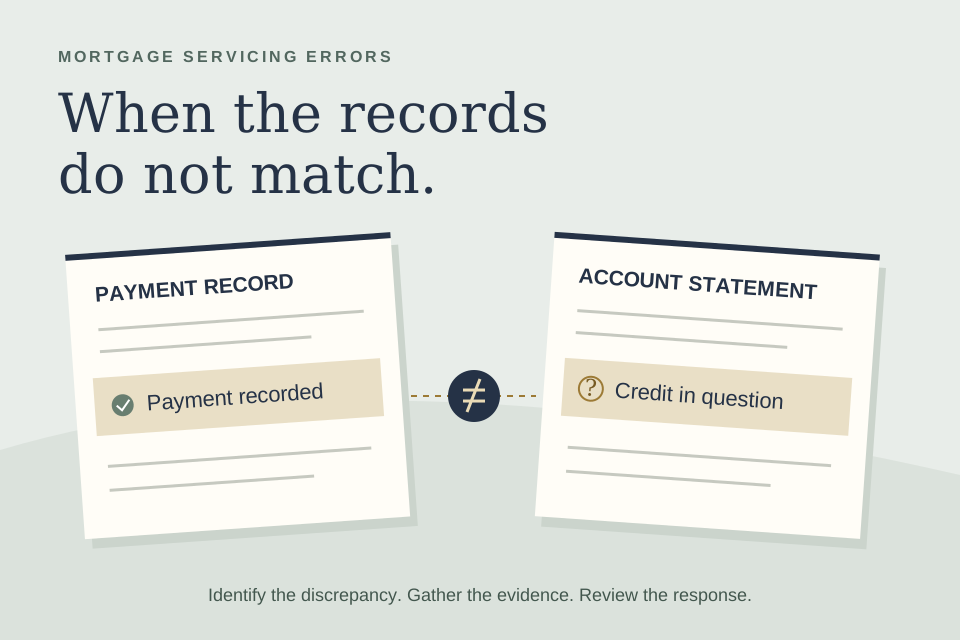
- Why you believe those records do not match.
- The missing information that would help resolve the issue.
Application-related concerns may also involve loan modification during foreclosure. If you are trying to catch up, review the reinstatement quote carefully. A reinstatement quote and a full payoff statement are not the same, and the same response rules should not simply be assumed for both.
Where should you send the request?
Check whether the servicer has designated an address for notices of error and information requests. It may differ from the payment address. Use the required channel and retain the request and proof of delivery.
A phone conversation is not a substitute for a qualifying written request. Do not put account numbers or confidential records into this website’s consultation form; ask how to provide documents securely.
How long does the servicer have to respond?
For covered requests, acknowledgment is generally due within five days and many substantive responses within 30 days, excluding Saturdays, Sundays, and legal public holidays. Exceptions, extensions, and shorter deadlines apply to particular requests. These are servicer-response periods, not extensions of your court deadlines.
Asking who owns the loan has a shorter deadline
A covered request for the identity and contact information of the loan’s owner or assignee generally has a 10-business-day response period, without the ordinary 15-day extension. Read §1024.36(d)(2) for the specific rule.
Ownership and the right to enforce the note are not identical. Florida §673.3011 recognizes that a person entitled to enforce an instrument need not be its owner. Have the records assessed rather than assuming an owner’s name proves or defeats standing. Our foreclosure defenses guide explains the broader review.
Act promptly—not at the edge of a response window
For the specific foreclosure errors described in §1024.35(b)(9) and (10), a notice received seven or fewer calendar days before a foreclosure sale is subject to a different rule: the servicer must make a good-faith attempt to respond, orally or in writing, to correct the error or explain why it concludes no error occurred, rather than follow the usual acknowledgment and investigation-response procedures.
This is not advice to wait until eight days before a sale. Receipt matters, not just the date you mail something, and the court schedule needs immediate attention. See §1024.35(f)(2).
Does a qualified written request stop foreclosure?
Not automatically. The information-request rule permits otherwise available remedies to continue while a request is outstanding. Certain foreclosure-related errors involve additional requirements, but there is no universal stay just because a homeowner sends a QWR.
Keep responding to the lawsuit as required. If you have just been served, start with the Florida foreclosure complaint and summons guide.
What if the servicer says no error occurred?
You may request the documents it relied on in reaching that conclusion. Under §1024.35(e)(4), responsive documents generally must be provided free within 15 business days after the servicer receives that request. You must request them within 90 days after receiving its response.
This is not a right to every internal file. Confidential, proprietary, or privileged information can be withheld under the rule, with the required written notice. Keep the original decision and the follow-up request together.
Does a notice of error affect credit reporting?
For an applicable notice of error, the rule restricts adverse credit reporting about the disputed payment for 60 days after receipt. This is not a freeze on the entire account, an automatic deletion of earlier reporting, or a payment holiday. Coverage and exceptions matter. See §1024.35(i)(1).
Can the servicer charge a fee to respond?
The rules generally prohibit charging a response fee or requiring a loan payment as a condition of responding. The information-request rule contains a limited exception for a state-permitted fee for a beneficiary notice. The borrower’s ordinary payment obligations remain separate.
What should you bring to a foreclosure attorney?
Bring a short timeline, mortgage statements, bank confirmations, written requests and delivery records, responses and supporting documents, and the complaint and hearing notices.
A concrete example—“My bank shows this payment cleared on this date, but the account history does not credit it”—is more useful than a broad statement that the balance is wrong. Overbroad, duplicative, or irrelevant requests can fall within exceptions. Focus on the information that matters to your account and case.
Find foreclosure information for your Florida county →
Sources and important context
- CFPB: 12 CFR §1024.35 — Error resolution
- CFPB: 12 CFR §1024.36 — Information requests
- Florida Statutes §673.3011
Published October 19, 2026. General educational information, not legal or tax advice. Coverage, deadlines, and available options depend on the loan documents and case history. Contacting the firm or sending a request to a servicer does not create an attorney-client relationship or itself suspend court proceedings. No outcome is guaranteed.