
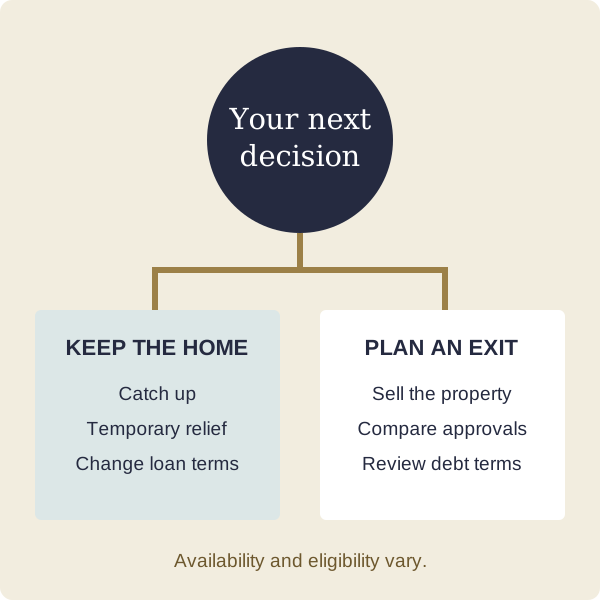
What does loss mitigation mean for a homeowner?
Your servicer may use the term when asking for an application, income records, or hardship information. It covers several possible approaches, including changes that help you keep the home and agreements that involve selling or transferring it. The available options depend on the loan, investor or program, eligibility, and the servicer’s review.
Start with your objective: can you afford the home going forward, do you need temporary relief, or would an orderly sale better fit your circumstances? A sustainable plan needs to account for taxes, insurance, and other household expenses as well as the mortgage payment.
Compare your mortgage options before choosing
Reinstatement
If you can pay the required arrears and charges, ask whether reinstatement remains available and obtain an accurate quote. It is distinct from paying off the entire loan.
Review reinstatement requirements →Forbearance or a repayment plan
Forbearance may reduce or suspend payments temporarily; missed amounts still need to be addressed. A repayment plan can add amounts to future payments to catch up. Confirm the payment schedule and what happens when relief ends.
Loan modification
A modification changes loan terms. Compare the proposed payment, duration, balance, and any amount deferred until later. A lower monthly bill alone does not tell you the total cost.
Understand modification during foreclosure →Traditional sale or short sale
A sale must fit the court timeline and resolve payoff and title requirements. If proceeds will not cover the mortgage, a short sale requires the necessary approvals and careful review of remaining-debt terms.
Compare selling options → Understand short-sale approval →Deed in lieu
This is an agreed transfer to the lender. Compare alternatives before giving up ownership, and confirm what the written agreement resolves. Other liens and title issues can affect whether it is available.
Review a deed in lieu →These choices are not available to everyone. Some loans have additional program-specific tools. First identify whether yours is FHA-insured, VA-backed, or part of a USDA program, then confirm current requirements.
What goes into a loss mitigation application?
Ask the servicer for its current document checklist and a reliable way to submit it. Requirements may include income information, bank statements, a hardship explanation, and information about expenses and other borrowers. Follow the actual checklist rather than assuming that sending a few financial documents makes the file complete.
- Keep a copy of each submission and proof of delivery.
- Ask what remains missing and when it must be supplied.
- Seek written confirmation of the application’s status.
- Keep decision letters, proposed agreements, and trial-payment instructions together.
- Tell your attorney about every hearing, judgment, or scheduled sale.
Use the servicer’s verified secure channel for sensitive financial records. Do not put account numbers or private documents in a public consultation form.
Does loss mitigation stop a Florida foreclosure?
Not automatically. Federal servicing rules may restrict certain foreclosure steps for qualifying applications, but coverage, completeness, timing, prior applications, and exceptions matter. The rules do not require a servicer to offer a particular option. A pending application also does not excuse every court obligation.
Our modification guide explains the application-timing protections. If an auction is approaching, read how to stop foreclosure in Florida and arrange an individual review rather than calculating a deadline from this overview.
What should you check in an offer or denial?
For an offer, ask what you must pay now, what changes later, and what happens to the arrears, fees, balance, and pending lawsuit. Review any trial period, signature deadline, and consequences of missing a payment. Do not assume that accepting an offer by phone completes the agreement.
For a denial, keep the letter and submission history. Some qualifying loan-modification denials carry appeal rights and deadlines. See what to review after a modification denial. If the account figures look wrong, the servicing-errors guide explains how a focused written request may help.
Where does foreclosure defense fit?
Loss mitigation concerns a possible mortgage resolution. Foreclosure defense addresses the lawsuit and whether the plaintiff has established its right to relief. The two can proceed together. Counsel can review the court papers and proposed arrangement so that negotiations do not cause an important response or hearing to be missed.
If the available arrangement is unaffordable, a broader review may include whether bankruptcy belongs among your options. Bankruptcy is a separate legal process, not another name for the servicer’s loss mitigation application.
Common loss mitigation questions
Is loss mitigation the same as a loan modification?
No. A modification is one possible loss mitigation option. Other approaches can include temporary relief, repayment arrangements, a short sale, or a deed in lieu.
Does loss mitigation forgive missed payments?
Not necessarily. An arrangement may require repayment now, over time, or later. Read the written terms to understand what remains owed and when it is due.
How long does a loss mitigation review take?
There is no single timetable covering every loan and option. Completeness, applicable rules, and requested updates matter. Ask for the status and outstanding requirements; do not assume the foreclosure will wait for the review.
Compare the offer with your Florida foreclosure timeline
Call Anthony Rumore, P.A. at 888-318-4550 for a free consultation about your foreclosure and mortgage options. Bring the application correspondence, any offer or denial, and your court papers. Find your county’s resources and prepare with our consultation checklist.
Sources and context
- CFPB: options when mortgage payments are difficult
- FHFA: loss mitigation for Enterprise loans
- CFPB: Regulation X section 1024.41
- CFPB: mortgage loan modifications
Sources checked November 14, 2026. General educational information, not legal advice. Options depend on the documents, facts, and applicable law. No outcome is guaranteed. Contacting the firm does not create an attorney-client relationship or stop a foreclosure.